
BDC Common Stocks Market Recap: Week Ended August 14, 2026
August 15, 2026
BDC COMMON STOCKS
Week 33
Wall Street closed out the trading week mixed, with the S&P 500 (SP500) climbing to another all-time high amid key inflation readings and a steady stream of corporate earnings.
The latest U.S. CPI print rose 3.4% year-over-year in July, easing from June’s 3.5% pace and matching forecasts, as a 0.1% monthly gain was driven mainly by shelter while energy costs fell and core inflation slowed to 2.5%.
At the same time, U.S. PPI data held flat in July against expectations for a modest rise, with the year-over-year rate cooling to 4.7% as a decline in goods prices offset gains in services and construction.
For the week, the S&P (SP500) added +0.36%, while the tech-heavy Nasdaq Composite (COMP:IND) ticked up +0.14%, and the blue-chip Dow (DJI) fell -0.56%.
WEEK IN REVIEW
One And Done?
BDC sector prices retreated slightly this week after a strong rally the week before.
Both the price of BIZD, the only BDC sector exchange-traded fund, and the S&P BDC Index fell (0.30%).
18 BDCs held or increased their price levels, but 27 dropped.
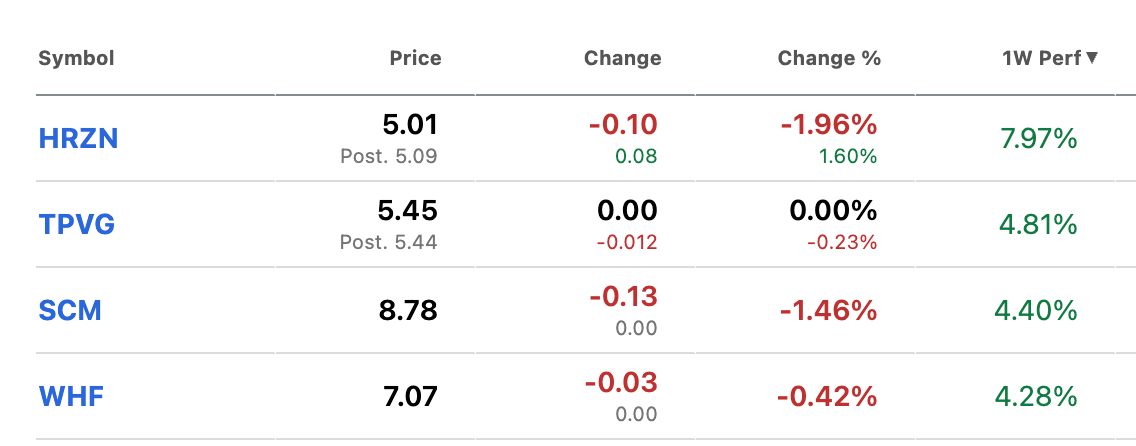
4 BDCs recorded price increases greater than 3.0%, but twice as many fell by 3.0% or more.
Here are the week's "winners" by that 3% limit:
On The Horizon
Apparently, investors are feeling optimistic about Horizon Technology Finance's (HRZN) outlook despite the BDC losing over 10% of its NAVPS in the IIQ 2026, following its merger with Monroe Capital (MRCC).
44 BDCs have reported their IIQ 2026 results, and HRZN's NAVPS loss is the largest.
Understandably, investors are looking forward, and HRZN is scheduled to pay out a medley of distributions, many promised before the merger was completed.
Subsequent to quarter end, [HRZN] declared distributions of $0.06 per share payable in October, November and December 2026, and, in accordance with the Company’s previously announced intent to make additional distributions with its undistributed net investment income, or “spillover” income, special cash distributions of $0.03 per share payable in October, November and December 2026
INVESTMENT VIEW
Other Metrics
The number of BDCs trading at or above their Net Asset Value Per Share (NAVPS) remained unchanged from the prior week at 10.
In Week 30, only 5 BDCs traded above NAVPS.
Almost Done
In terms of news, this week saw a final group of BDCs reporting their IIQ 2026 results.
This included Investcorp Credit Management BDC (ICMB), the BDC most likely not to be around in a few weeks.
On Friday, the BDC Reporter summarized ICMB's latest 10-Q.
Initial Findings
We've now provided a performance rating for every BDC that has reported its results. See the BDC Performance Table for each BDC's rating.
Once we hear from PSEC, we'll write a full-fledged quarterly review.
We can say at this point, and made very clear in the BDC Performance Table and in the BDC NAV Change Table is that the IIQ 2026 was a much better one than the dismal results in the IQ 2026, when 37 BDCs under-performed to varying degrees.
On the other hand, plenty of BDCs continue to post results below our reasonable expectations and those of their shareholders.
Keeping Busy
The BDC Reporter spent much of the week spelling out the positive and negative developments by BDC in the Individual BDC Performance Table.
We're not done yet, because we spent a great deal of time reviewing the earnings release, latest 10-Q, investment presentation, and conference call. Moreover, more than ever before, we're digging into every BDC's Schedule of Investments, looking beyond the number and percentage of non-accruals to evaluate portfolio credit quality.
This week, we published our "deep dives" into Bain Capital Specialty Finance (BCSF) and Carlyle Secured Lending (CGBD).
Overall, if you go to the Individual Performance Table, you'll see we've covered 15 BDCs, or a third of the total.
WHERE WE STAND
So Close
Thanks to the prior week's momentous rally, the BDC sector sits close to breaking even 33 weeks into 2026.
BIZD is down 5.7% in price alone in 2026.
The BDC S&P Index, calculated on a total return basis, is only 1.7% off.
By way of contrast, in Week 30, BIZD was off 13.0%.
The S&P BDC Index was down 13% back in March.
However...
The picture is a little more unsettling when we look at individual BDC prices in 2026.
According to the Seeking Alpha data we use, only 9 BDCs are in the black price-wise this year:
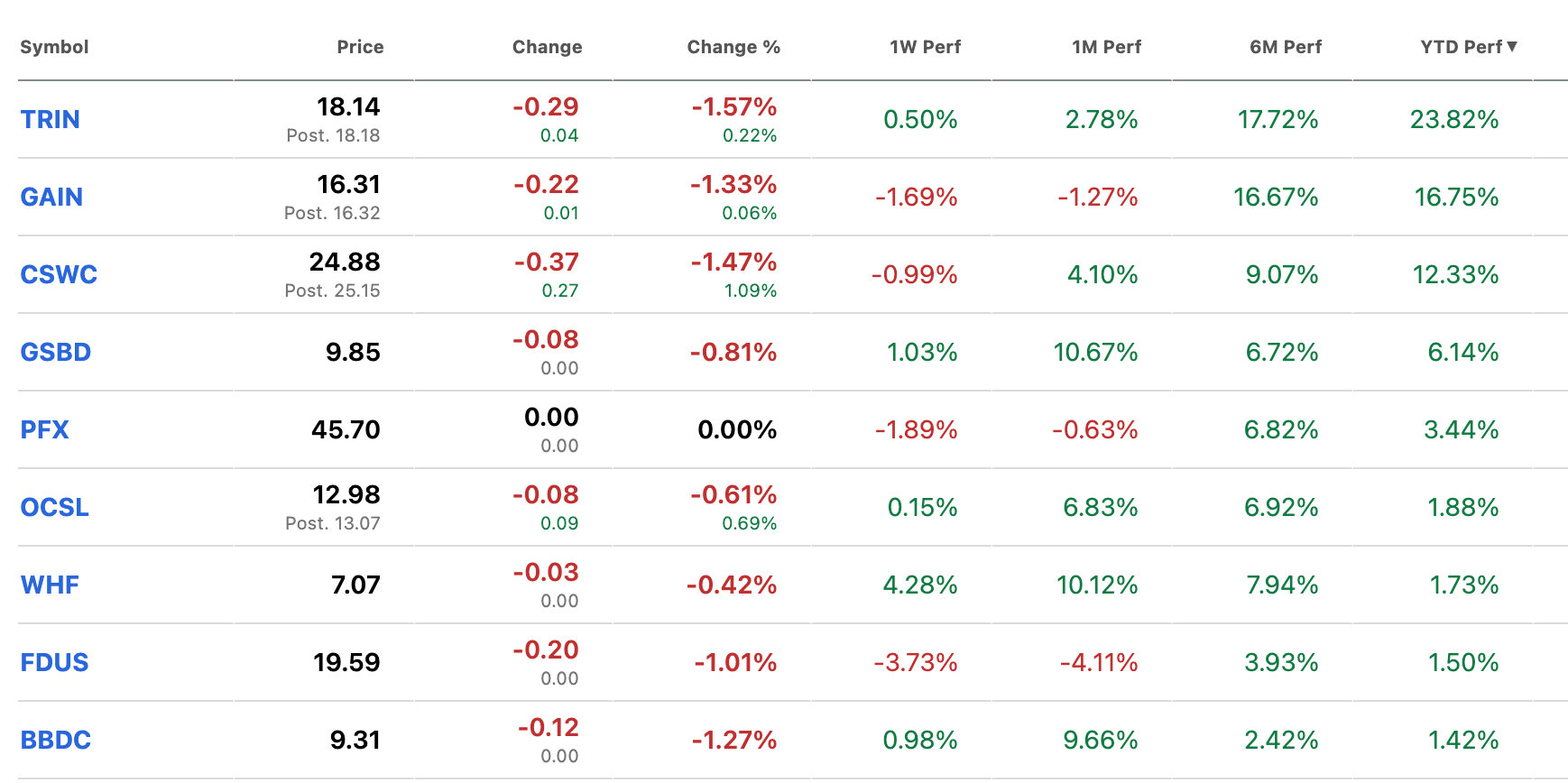
Even perennial investor favorites like Ares Capital (ARCC) and Main Street Capital (MAIN) are still in the red, even as the former maintained an unchanged dividend through three quarters of the year and the latter upped its payout.
Moreover, some of the red ink spilled has been outrageously high. Here are all the BDCs down by 20% or more:
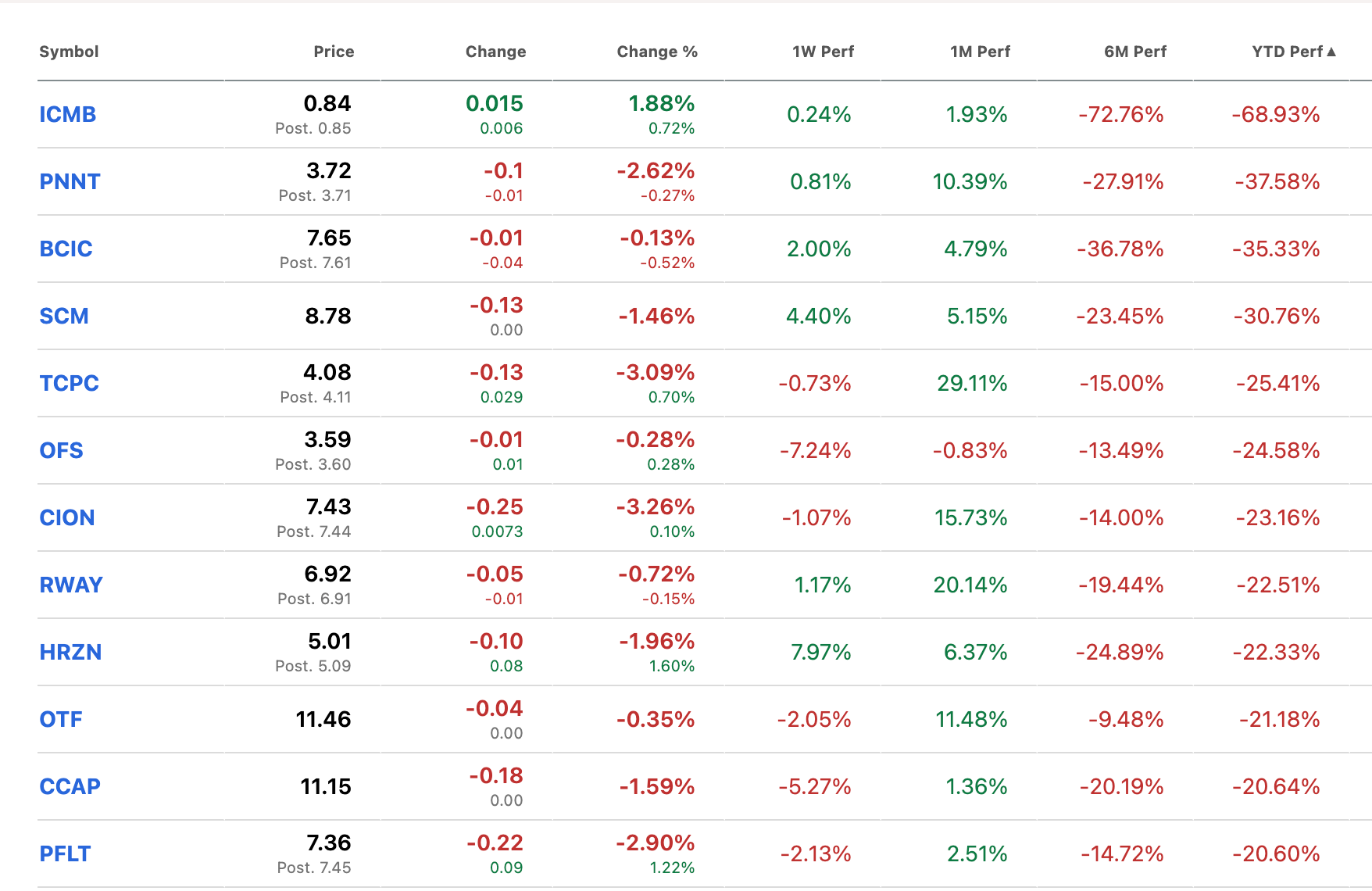
At this point, many BDC investors must still be nursing their wounds and wondering if that's "as good as it gets", as Week 32's rally has clearly faded in Week 33.
WHERE WE ARE HEADED
Funny Peculiar
We've seen a host of BDC rallies in the twenty-plus years we've been involved in this market.
Pretty much any sort of pattern can happen.
The most prevalent one, though, is that BDC prices suddenly take off, as they did two weeks ago, and keep on going for quite a while as investor confidence in the sector and its prospects returns.
As in most stock rallies, most price gains happen in the first few days while the majority of would-be investors decide whether to jump back in.
Early birds tend to catch the worm, but they're also most at risk of misreading the situation.
Many speculators among BDC investors are waiting for those sweet, sharp price increases and are ready to "jump out" as quickly as they jumped in when momentum fades.
In Our View
On The Other Hand
The above is our unvarnished view, which informs our investing and explains why we've not loaded up on BDC common stocks in recent days.
However, there's an alternative scenario that could play out, especially for the "better" BDCs that have underperformed price-wise despite posting decent fundamentals.
Earlier, we mentioned ARCC and MAIN, but several other BDCs of the same ilk have also suffered big price drops despite performing almost as well as they've ever done.
Should the angst surrounding Private Credit begin to clear, it's quite possible that this relatively small cohort of BDCs might catch investors' fancy again.
If ARCC were to return to its 52-week high, that would be a 14% price increase. For MAIN, a similar move would result in a 15% gain, and Blue Owl Technology Finance (OTF) would jump 38%.
Also, if any of the BDCs that have underperformed performance-wise truly "turn themselves around" in terms of credit, we could see run-ups in their prices as well.
One Amongst Many
Just such a hope has already caused Oaktree Specialty Lending (OCSL) to increase in price by 14% since late June:
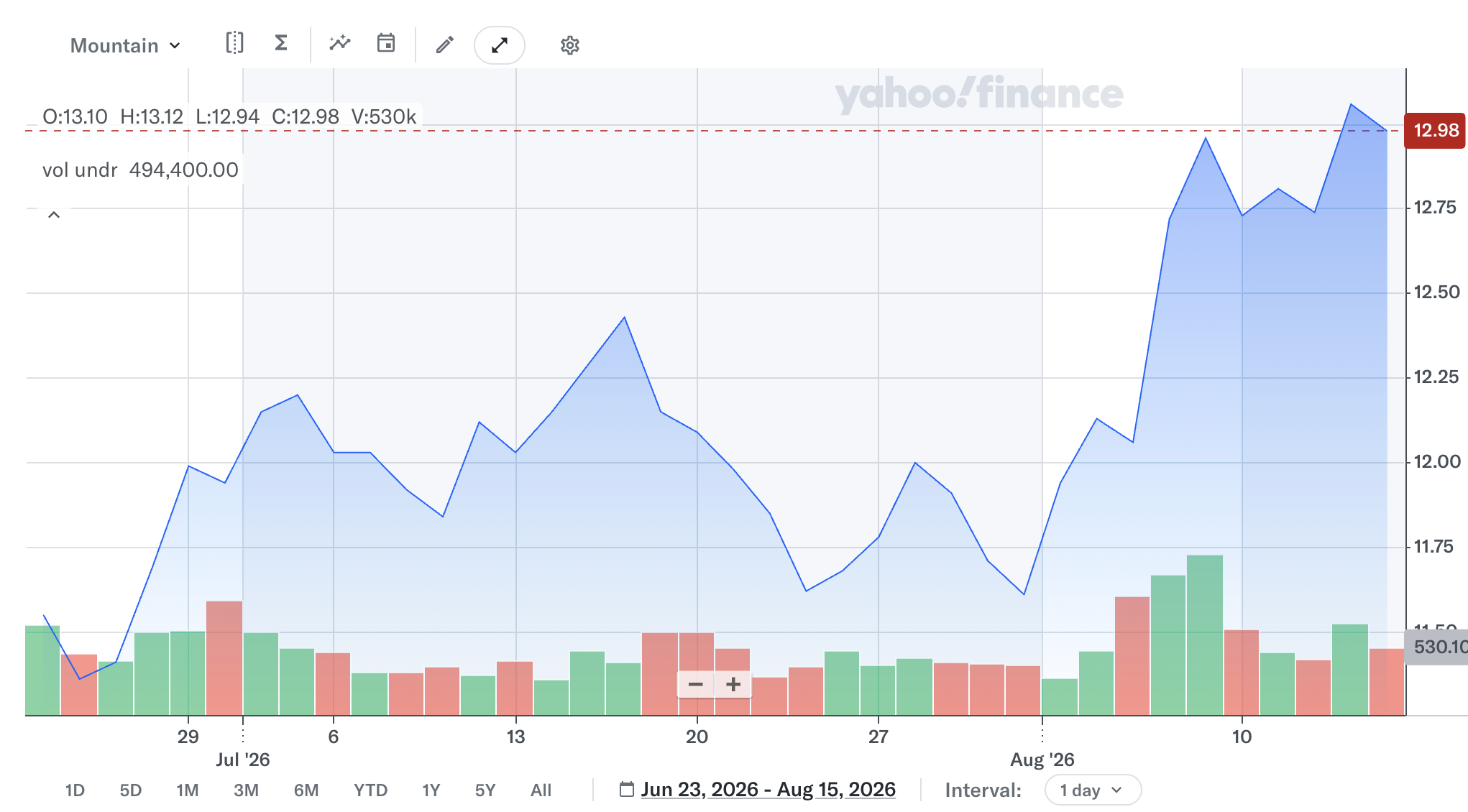
In the IIQ 2026, OCSL's NAVPS increased by 0.1% after several years of decline beginning in the IQ 2022, which saw this metric drop by 29%.
Investors are quick to forgive if they believe the future will look better than the past.
Overall, 7 BDCs that had experienced significant NAVPS losses in the recent past saw this metric increase in the IIQ 2026, and all have experienced outsized price increases in recent days.
See the BDC NAV Change Table for the BDCs involved.
The question remains: where these one-quarter wonders or the beginning of a renaissance?
We'll share our views for each on these pages in the Subscriber Tools in the days and weeks to come.