
BDC Common Stocks Market Recap: Week Ended June 5, 2026
BDC COMMON STOCKS
Week 23
Here We Go Again
After a week's reprieve, BDC sector prices returned to the red.
The sector overall - as measured by its only exchange-traded fund with the ticker BIZD or the S&P BDC Index - fell (1.2%) and (1.0%), respectively.
Maybe BDC investors took some comfort that - for once - BDCs outperformed the broader markets, which, as shown above, had a bit of a meltdown on news that employment numbers were solid in America.
However, there was little else to cheer.
38 BDCs dropped in price, and only 7 were up or unchanged.
9 BDCs decreased in price by (3.0%) or more and 2 BDCs increased by 3.0% or more.
Coincidentally, this is exactly the inverse of the prior week, but with different BDCs in the two categories.
Up
The two 3.0% winners this week were PhenixFin (PFX), a tiny BDC that trades an average of 1,785 shares per day, and whose price always bounces around.
PFX was up 8.31%.
In second place was Horizon Technology Finance (HRZN), which rose 4.75% on no particular news.
That's probably no great comfort to any long-term HRZN shareholders, as the venture-debt BDC is still down (29%) year-to-date.
Otherwise
The number of BDCs trading at a premium to book value remained unchanged at 6.
For the record, here are the tickers of the half dozen BDCs able to boast of trading at a premium to book: CSWC, GAIN, HTGC, MAIN, TRIN, and TSLX.
By contrast, we calculate that the average BDC price to net asset value per share is 79% - a discount of (21%).
New Lows
We like to keep track of the identity and number of BDCs reaching new lows or highs - just the former at the moment - as a way to assess market direction.
This week, there were at least 3 new 52-week lows set by Carlyle Secured Lending (CGBD), Investcorp Credit Management (ICMB), and Runway Growth Finance (RWAY).
There really wasn't any "bad news" to point to as an explanation for this price softness.
RWAY successfully placed $50mn of unsecured notes with an institutional debt investor, using the proceeds to pay down its Revolver and boost its liquidity.
The new debt should not materially impact its borrowing costs, as the new 3-year unsecured notes cost roughly the same as the BDC's Revolver.
While We're On The Subject
RWAY was not the only BDC tapping the debt markets.
In recent days, several other BDCs have successfully raised medium-term capital, including FS-KKR Capital (FSK), Blue Owl Technology Finance (OTF), Gladstone Capital (GLAD), and New Mountain Finance (NMFC) - all funded by institutional money.
We did note in the BDC Reporter's News section that we didn't understand why FSK was raising so much money on mediocre terms, many months before needing to refinance $900mn in very inexpensive notes issued in the ZIRP days.
Otherwise, we'll just point out that several of these issues have been for 3-year terms rather than the traditional 5-year term. That puts a lid on interest expense and leaves the BDCs hopeful that, 36 months from now, they will be able to borrow at lower rates.
However, there's an upfront cost in these financings that will be spread over a shorter period, and there's a chance rates may not decline neatly in the years ahead for all the reasons our readers must be familiar with.
Bickering
In some cases, the BDC Reporter questions whether raising new debt at these high yields is actually accretive to shareholders, even if favorable to the external managers, which will have more assets to charge management fees on. There's an argument that we've made before that some BDCs might be better off shrinking their balance sheet, becoming more selective about new investments, and keeping their head down till market conditions - both for lending and borrowing - improve.
The math suggests that, in some cases, risk-adjusted per-share earnings might benefit from such an approach.
Unfortunately, most BDC managers seem to regard right-sizing their balance sheets as a sign of weakness, which it isn't when your borrowing costs, management fees, and incentive fees exceed the yields received on new loans, adjusted for reasonable credit losses.
WHERE WE STAND
Very Low
At the moment, BIZD is trading at a price of $12.49, just 4% above its 52-week low of $11.97 and down (11.9%) in 2026.
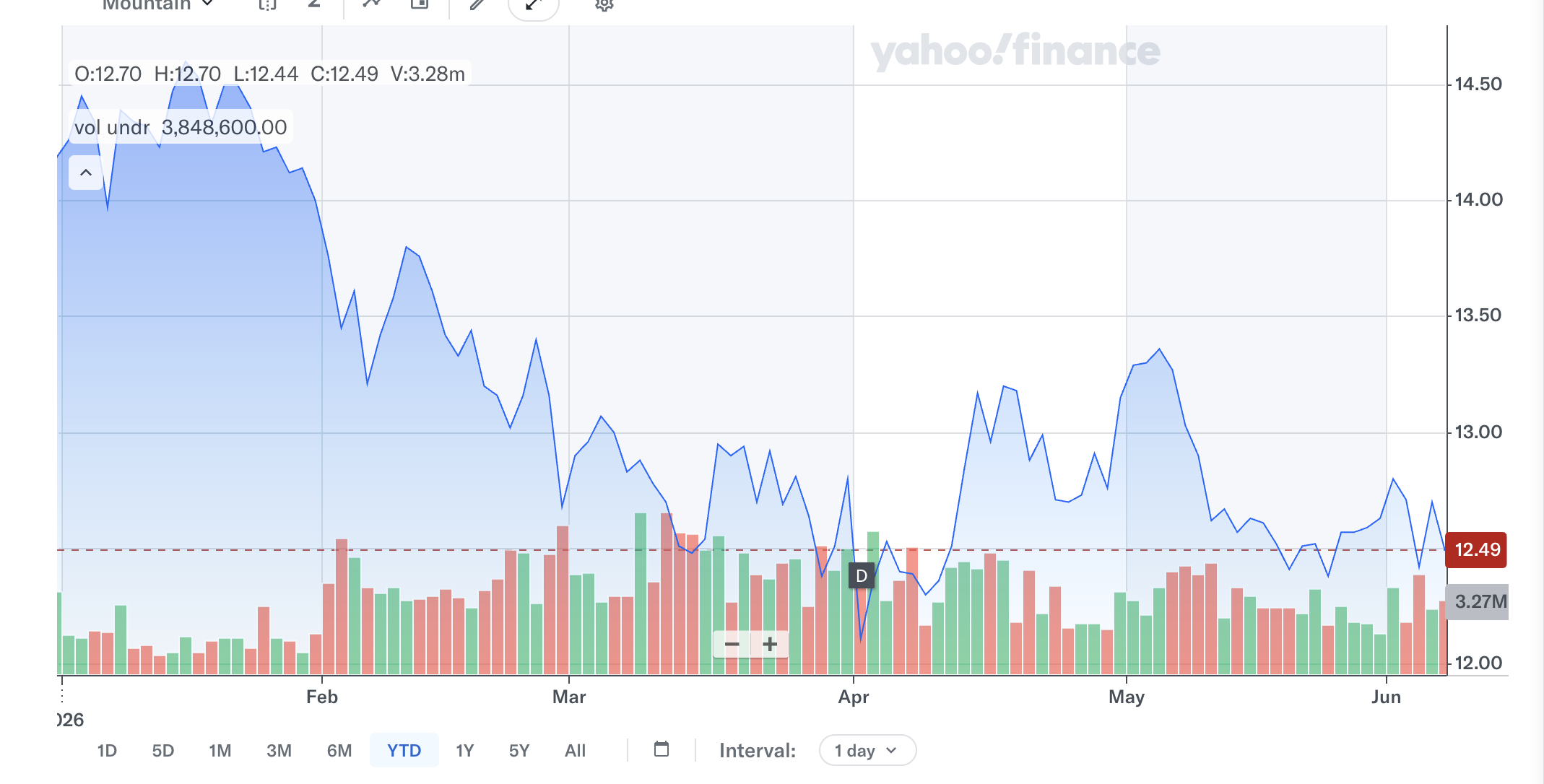
The ETF sits (26.3%) below its 52-week high and (30.1%) off of its peak on February 21, 2025, the unofficial end of the BDC sector's Golden Years.
History Lesson
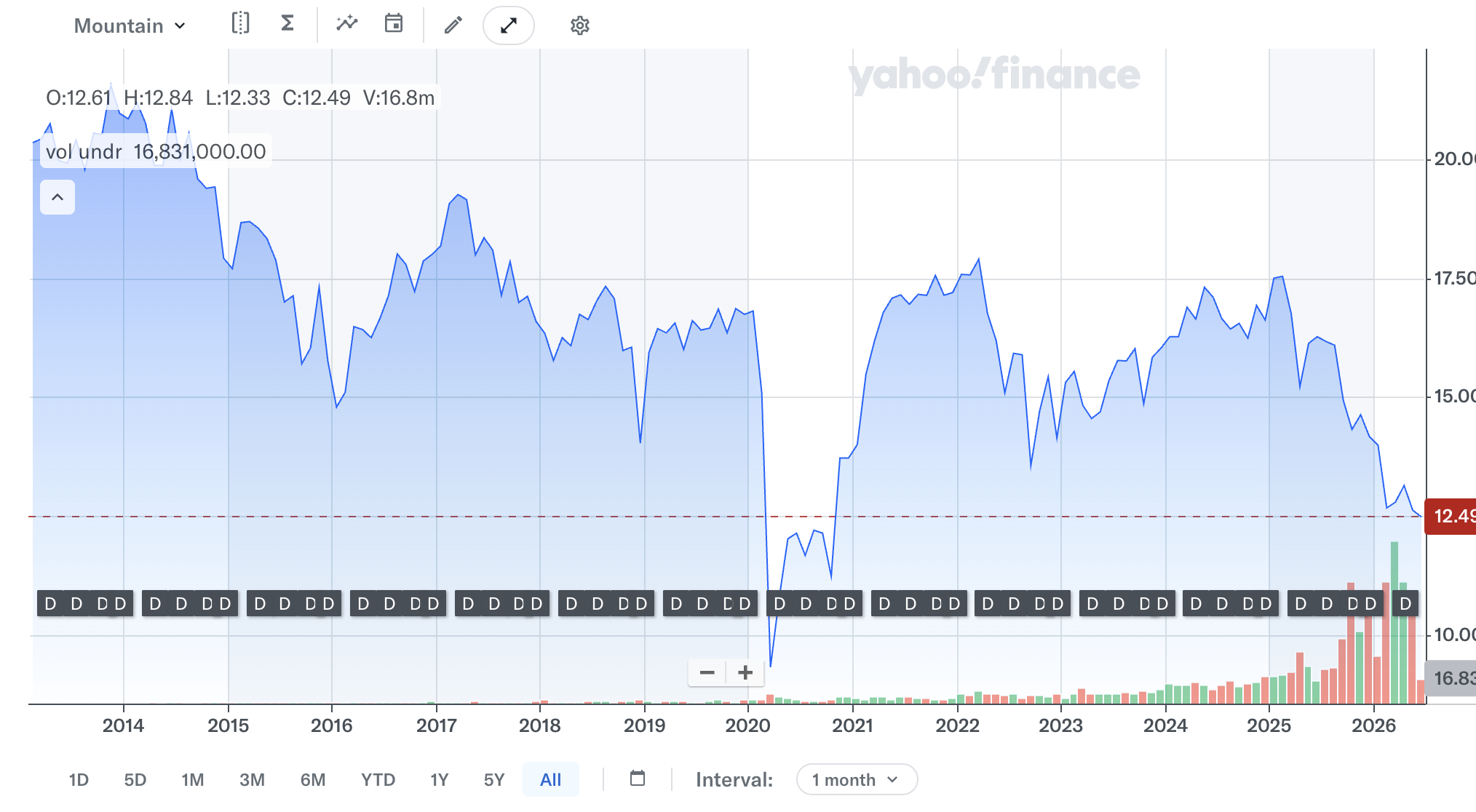
We would argue that the period began in September 2022, when the markets recognized that no recession was forthcoming. At that point, BIZD had slumped to $13.42 - the lowest level in its history outside the Covid period.
Price-wise, the Golden Years - actually 10 quarters - saw BIZD increase by 33%.
This was a reasonable response to the higher earnings and ever-larger payouts that followed the ZIRP-era, which ended in March 2022, when the Fed realized that inflation was not "transitory" and began its aggressive rate-raising campaign.
For those of you who might have forgotten, at the time of the first rate increase, the Fed Funds rate was in a 0.00%-0.25% range, and SOFR was priced at only 0.05%!
We remind you of all this to show how far the BDC sector has fallen outside of the YTD and 12-month time frames one typically uses.
At this point, BIZD has fallen below the level of September 2022 and is trading close to its 13-year low, once again, except for the unusual conditions of the 2020 Covid freak-out.
So Many
This year, 40 of the 45 BDCs we track are in the red price-wise, 42 if we look one year back. Even if we go back 3 years to June 2023, when there were 39 BDCs trading, 30 are in the loss column in terms of their prices.
Switching to the S&P BDC Index, which gives us sector performance results on a total return, we are down (9.4%) YTD in 2026 and (11.4%) over the last 12 months.
Only over a 3-year period does the BDC total return look even decent: 6% per annum on average in the black thanks to those above average dividends through most of the period.
WHERE WE ARE HEADED
Sorry
We'd like to say that the worst is behind us and that better times are ahead for BDC stock prices.
Then, BDC investors could comfortably clip their dividend coupons, which are averaging in the low-to-mid teens in terms of percentage returns, as well as benefiting from even a modest pick-up in BDC prices.
In that sort of scenario, BDC investors might see a return of 25% or more in the next 12 months, even if stock prices only returned to the level BIZD was at in September 2022, on the eve of the Golden Years.
Only over a 3-year period does the BDC total return look even decent: 6% per annum on average in the black, thanks to those above-average dividends through most of the period.
That could happen from where we are today, but that's not the likeliest scenario.
Ever More?
More likely - and BDC price movements in recent weeks seem to suggest - is that prices will continue to deteriorate.
This is more due to that ineffable factor - investor confidence - rather than fundamentals.
The malaise surrounding Private Credit - to which public BDCs are inextricably linked - continues.
In the midst of a strong economy, full employment, and a government willing to prime the spending pump, the skepticism continues that Private Credit is a house of cards.
Here is a long analysis about Pimco's views on the subject, which serves as an exemplar for many others. It makes for hard reading, and we disagree with most of the assertions and conclusions, but it's not our viewpoint that moves markets, but the likes of PIMCO:
The Bear's Case
Pimco has repeatedly warned that Private Credit's massive post-2008 fundraising spree has severely degraded underwriting standards, setting the stage for significant pain. Here is how PIMCO has framed the risks regarding future loan losses and asset quality:
1. The "Full-Blown Default Cycle"
In a recent analysis by PIMCO credit analysts Lotfi Karoui and Gabriel Cazaubieilh, the firm warned that direct-lending vehicles are entirely untested against modern economic shocks and are due for a severe stress test.
The Concern: They explicitly stated that the industry is facing a "full-blown default cycle." They noted that, like all mature leveraged financing sectors, direct lending cannot indefinitely delay the reality of macroeconomic headwinds.
The Mechanism: PIMCO pointed to an overconcentration of risk in specific sectors, such as software and technology. Many of these companies were financed at peak valuations and are now highly vulnerable to AI disruption and the sustained burden of higher debt servicing costs.
2. Inflated Ratings and Low-Quality Borrowers
Daniel Ivascyn, PIMCO’s Chief Investment Officer, has been highly critical of the underwriting quality in the space, noting that a massive influx of capital has forced institutions to aggressively compete for loans, often at the expense of fundamental credit analysis.
The Concern: Ivascyn warned of "dangerous" assumptions in the credit market, highlighting that inflated credit ratings from third-party agencies are giving investors a false sense of security. He noted that institutions are effectively "grabbing loans" from lower-quality businesses just to deploy cash.
The Mechanism: When too much money chases too few good deals, underwriting standards loosen. Ivascyn noted that if economic growth weakens, these aggressive underwriting tactics will translate into a sharp rise in credit losses, adding that regulators will be "unwilling to bail out the same industry twice."
PIMCO's ultimate stance is that private credit's much-touted "stability" is largely an illusion created by a lack of mark-to-market pricing, and that a sustained, painful default cycle is already underway beneath the surface.
Rightly or wrongly, this is the dominant narrative in Private Credit right now and has been for nearly a year.
That's unlikely to end until the fate of hundreds of highly leveraged software borrowers, at least a fifth of all BDC investments, becomes clearer.
Never has such a large proportion of Private Credit investments been the subject of credit doubt.
The sorts of losses the nay-sayers are predicting for Private Credit/BDC portfolios would greatly reduce both book value and profitability.
The current prices of BDCs do not even begin to reflect those sorts of losses, should they occur.
The bulk of the BDC price pullback we've experienced to date reflects the impact of lower interest rates and narrower spreads.
There's plenty of room for the prices of some BDCs to fall much further.
The BDC Credit Reporter Gets A Word In
As we've said, we don't agree with Pimco and the many other modern-day Cassandras.
Over at the BDC Credit Reporter, we've been reviewing BDC portfolios in great detail for years.
It's possible that we are not seeing the forest for the trees, but the evidence to date is more nuanced than what we're hearing from the critics.
We actually go to the trouble of rating each BDC on a 1-to-5 credit scale in this regard, and have just completed an across-the-board review through the IQ 2026.
The Credit Reporter looks at a slew of historical data about each BDC's credit performance, including gains and losses, the level and trends in underperforming investments, and changes in non-accruals. And much more besides.
We also identify, for every BDC, all companies valued at distressed levels (discounted below 80% of cost), track their unique stories, and estimate what ultimate losses might look like and the resulting impact on each BDC's capital and earnings power.
Anyway, there are twice as many BDCs performing well from a credit standpoint than are imploding, and a number in the middle that could go either way.
What we don't see is any evidence that BDC investors will face a sector-wide "sustained, painful default cycle" as the credit chickens come home to roost.
More likely, most BDCs in the years ahead will "keep on carrying on", while a significant minority who have adopted the wrong strategy and/or failed at their underwriting will get wound up in one way or another.
More History
By the way, this has always been the way public BDCs work. Some succeed, and some fail.
Most BDCs in the years ahead will "keep on carrying on", while a significant minority who have adopted the wrong strategy and/or failed at their underwriting will
We've seen American Capital, Allied Capital, Patriot Capital, Medley Capital, Sierra Income, Triangle Capital, Alcentra Capital, and - most recently - Monroe Capital get rejigged. (That's not even a complete list.
For BDC investors, Job 1 is to distinguish, as best as possible, which BDCs will thrive and which might fail.
In the short run, though, amid pervasive anxiety, prices across all BDCs are likely to remain under pressure.