
BDC Common Stocks Market Recap: Week Ended October 2, 2026
October 3, 2026
BDC COMMON STOCKS
Week 40
Wall Street ended the week on a mixed note as cooler-than-expected September jobs data cut Fed rate-hike odds even as Treasury yields climbed, with the 30-year hitting its highest level in decades.
For the week, the blue-chip Dow (DJI) fell -1.26%, the benchmark S&P (SP500) lost -0.27%, and the tech-heavy Nasdaq Composite (COMP:IND) climbed +0.45%.
Seeking Alpha- Wall Street Breakfast Extract - October 3 2026
WEEK IN REVIEW
Awful
This was one of the worst weeks in some time for the BDC sector, price-wise.
The VanEck-sponsored BDC exchange-traded fund, ticker BIZD, ended Friday, October 2, 2026, at $12.32.
That was down 4.6% and the biggest weekly percentage drop since Week 41 of 2025.
In just the last two weeks, BIZD has dropped 5.9%.
Of the 45 public BDCs we track, 39 dropped in price, and 6 were unchanged or increased.
Amongst the many BDCs in the red, 16 fell by 3.0% or more.
For illustrative purposes, here is a table drawn from Seeking Alpha showing the BDCs that fell 5.0% or more:
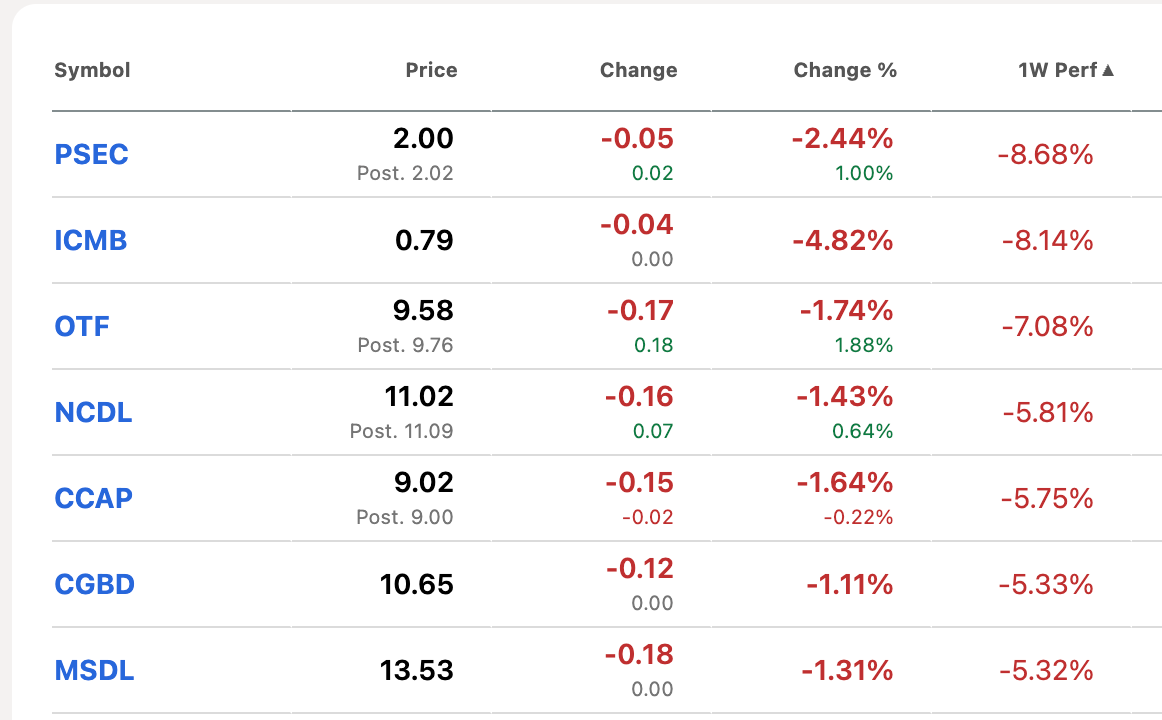
The number of BDCs down by more than 3.0% is the highest since the week ended July 24, 2026, when BIZD closed at $12.34.
In the intervening 10 weeks, the BDC sector has gone nowhere.
The upward price nudge during the latest earnings season is long forgotten.
So Many
Also notable is how many BDCs hit a new 52-week low this week.
We count 12.
That's the highest number since Week 25, when 13 were in this category.
Need we say that there was no BDC reaching a new 52-week high this week?
There's been no new 52-week price high in three weeks as the lower tide has been sinking all boats, including that handful of BDCs that have performed well in 2026.
Unchanged
A little surprisingly, the number of BDCs trading at or above book value remains unchanged at 5.
That's probably because the market seems to be punishing the more marginal BDC performers more harshly than the elite.
Everybody
However, over the last month, not one BDC increased in price. Every single one was in the red, between -1% and -16%.
The "best poor performer" is Sixth Street Specialty (TSLX) and the worst is Blue Owl Technology Finance (OTF), down -16%.
Quiet
All the tremulous price changes this week occurred despite little BDC news.
However, CION Investment (CION) successfully completed a series of previously promised transactions, which will moderately deleverage the BDC.
We wrote a full-length article on the subject.
Also, unsecured, medium-term BDC debt issuance continued, with Trinity Capital (TRIN) added to a long list of recent issuers.
Bloomberg reported that Prospect Capital (PSEC) may issue a new bond in the public market soon, with a yield of about 8.0%, but we've seen no further details.
Opportunity Knocked
As we watched BDC prices descend and found little to report, we used the time to complete the IIQ 2026 financial performance reviews for every BDC.
See the Individual BDC Performance Table for our summaries on all 45 public BDCs.
We're also carefully reviewing the investment outlook for every BDC in this lower-price environment and adjusting the BDC Best Ideas Table accordingly.
Hard as it is to imagine doubling down right now in this "falling knife" environment, it's markets like these that sometimes offer the best long-term opportunities.
Over the weekend, we'll revise our Market Outlook and Strategy views in the BDC Best Ideas Table to reflect the changing situation.
We are, as Rudyard Kipling would have suggested, trying to keep our head while all about us are losing theirs.
It's harder than it looks, as we'll discuss further below.
WHERE WE STAND
Running Out Of Synonyms For Dismal
At Week 40, with 9 months of the year and a couple of days gone, BIZD is down 13.1%.
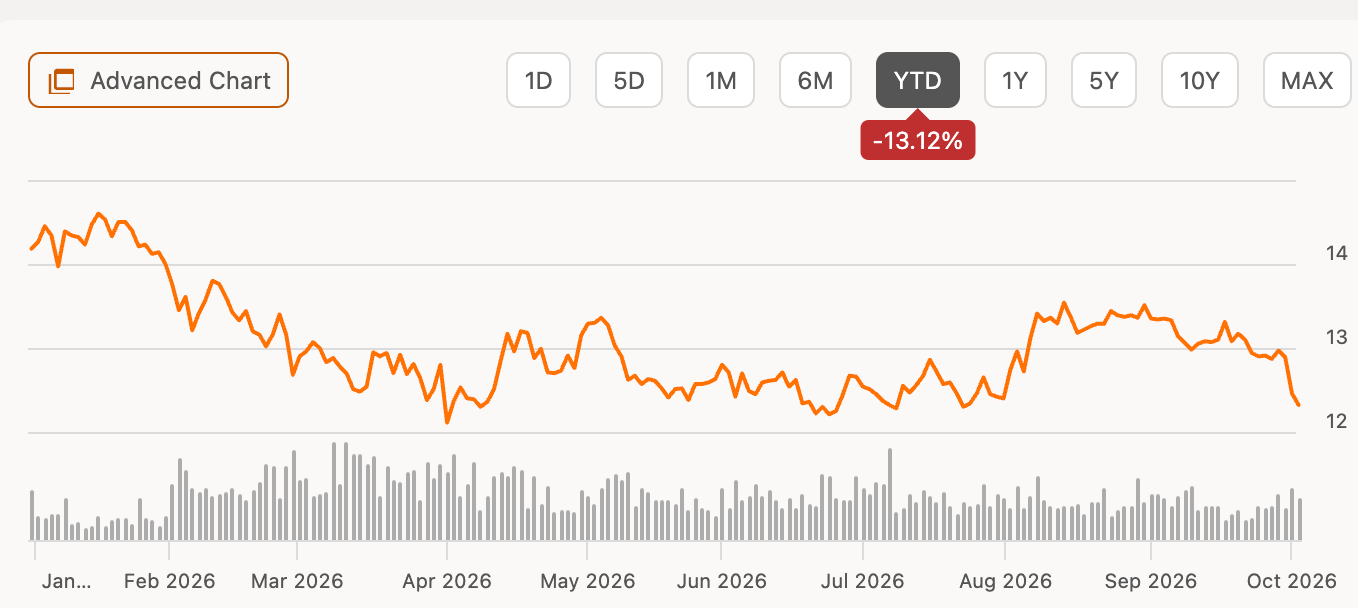
Based on the weekend numbers we gathered for this Recap, this is the lowest level we've reached this year.
BIZD is trading only 3% above its 52-week low and 19% below its 52-week high.
If we compare Friday's price with the peak price reached in February 2025 - before things began to fall apart - BIZD is down 30%, or over $5 a share.
On a total return basis, Gemini calculates that BIZD is down about 5%, without dividend reinvestment, and about 4% for those investors brave enough to buy more shares in a falling market.
The S&P BDC Index is down 7.1% on a total return basis.
Year-To-Date
Right now, only 5 BDCs have a higher price in Week 40 than at the end of 2025.
Here is the (short) list:
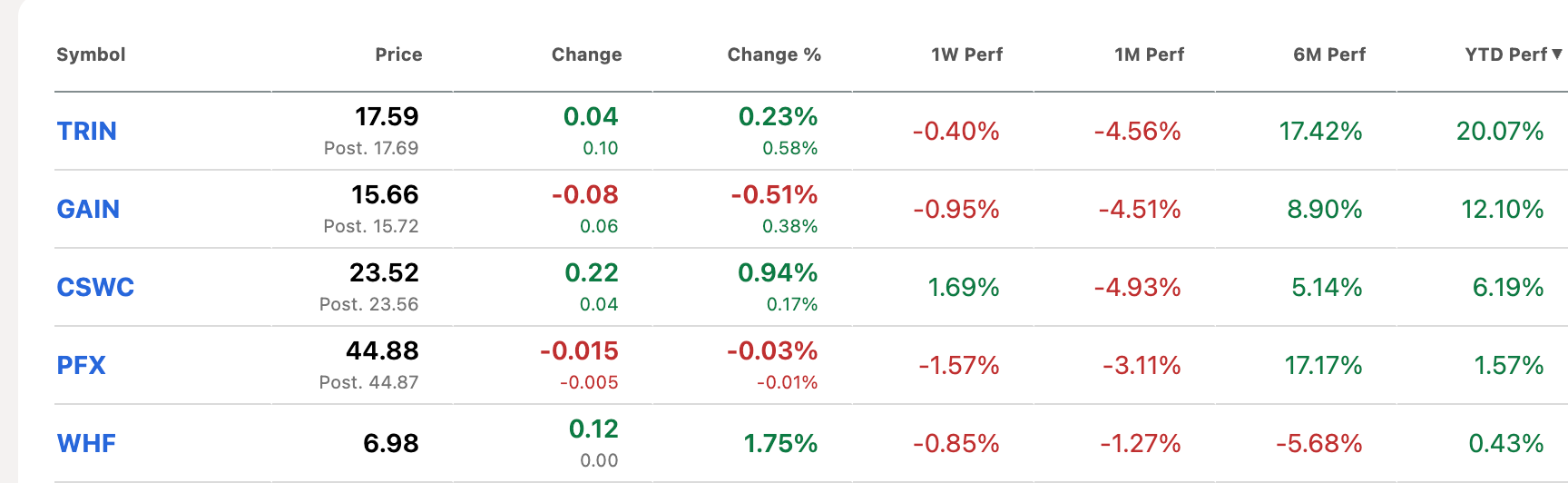
One can't help comparing this handful of out-performers with the 5 BDCs at the other end of the 2026 YTD price table:
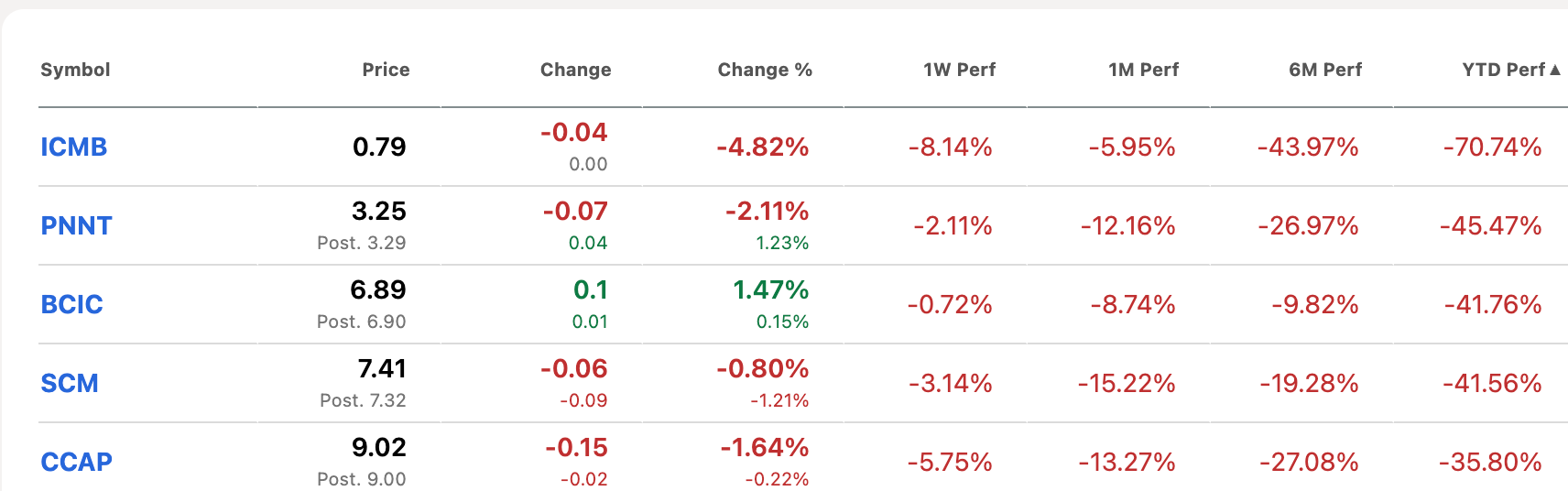
Just to state the obvious, investors have ruthlessly punished these BDCs, and many others, by a much bigger margin than they have rewarded the top names.
Odious
As this analysis we've whipped up with Gemini shows, 2026 appears to be headed to be as poor a year as 2025 for BDC investors:
Comparison: Full Year 2025 vs. 2026 YTD
| Metric | Calendar Year 2025 | 2026 YTD (Through Oct 2, 2026 Close) |
| Starting Share Price | $16.63 | $14.18 |
| Ending / Current Price | $14.18 | $12.32 |
| Price Change ($) | -$2.45 | -$1.86 |
| Price Return (%) | -14.73% | -13.12% |
| Cash Dividends Paid | $1.6708 (4 quarters) | $1.1209 (3 quarters) |
| Cash Yield on Start Price | +10.05% | +7.90% |
| Total Return (No Reinvestment) | -4.69% | -5.21% |
| Total Return (With Reinvestment) | -5.02% | ~ -3.5% |
Core Drivers
- Price Contraction Continuity: BIZD has continued its multi-year downward valuation re-rating. The drop from $14.18 to $12.32 represents a -13.1% price return YTD in 2026, tracking closely to 2025's full-year price decline of -14.7%.
- Dividend Absorption: With 3 quarters of payouts banked ($1.1209), cash distributions offset roughly 60% of the YTD capital loss. However, absent the Q4 distribution (typically declared in late December), the un-reinvested total return sits at -5.21%, slightly lagging full-year 2025's -4.69%.
- Reinvestment Divergence: Unlike 2025—where a steady downward glide meant reinvested shares dragged down total return (-5.0% vs. -4.7%)—2026 saw lower entry points during the spring lows, allowing compounding to reduce the net drawdown to roughly -3.5%.
WHERE WE ARE HEADED
First Things First
Before we get out the old crystal ball, let's discuss why BDC prices have - once again - begun to slump.
Back in Week 32, the BDC sector rallied 8% when IQ 2026 results were not as poor as expected.
That was true in and of itself, but we warned at the time that our initial review of the 45 set of results suggested many BDCs were still contending with performance challenges.
As of our latest count in the BDC Performance Table, 23 BDCs underperformed (rated 3 through 5) to some degree.
That was better than 37 in the IQ 2026 but worse than the 15 we counted in the IIIQ 2025 when we began the Performance Table.
The mini-rally notwithstanding, we imagine investors will continue to worry about many BDCs' ability to perform, both in earnings and credit.
We certainly do.
For what it's worth, the BDC Reporter believes only 10 BDCs are likely to perform as shareholders have a right to expect in the quarters ahead.
That's a very low percentage in a growing economic environment, where credit losses are, generally speaking, nothing out of the ordinary.
Up To Date
More recently, we've had the much-discussed surge in medium and long term yields, which has touched off "a global bond route".
Here is the classic explanation for why BDC prices have dropped in the face of these conditions:
In fundamental valuation models (like Dividend Discount Models or Net Asset Value multiples), the discount rate applied to future cash flows is tied to the risk-free rate plus an equity risk premium. When the risk-free rate rises, the required rate of return goes up. If cash flows remain constant, a higher discount rate mathematically reduces the present value of the stock, compressing price-to-NAV (Net Asset Value) multiples.
Fair enough, and adding to the pressure on BDC prices was this week's "cooler" nonfarm payroll report and the ensuing slight uptick in the unemployment rate.
The markets, which just before were certain we'd see an increase in the Fed Funds rate at the next meeting, decided the increase might not come until December after all.
That was a negative for BDC investors, who were hoping for a higher base rate on all those floating-rate loans out there.
Outlier
Even more chill-inducing is the remote prospect that weak employment numbers presage an economic downturn, despite the recent red-hot consumer spending data.
A recession, or even slower GDP growth, is not on our dance card, but we remember that markets have often hallucinated about recessions ahead, with disastrous consequences for BDC prices.
The most recent unnecessary freakout occurred as recently as 2022.
Here is a chart to remind anyone who was not around at the time what can happen to BIZD when the market begins to believe a recession is around the corner:
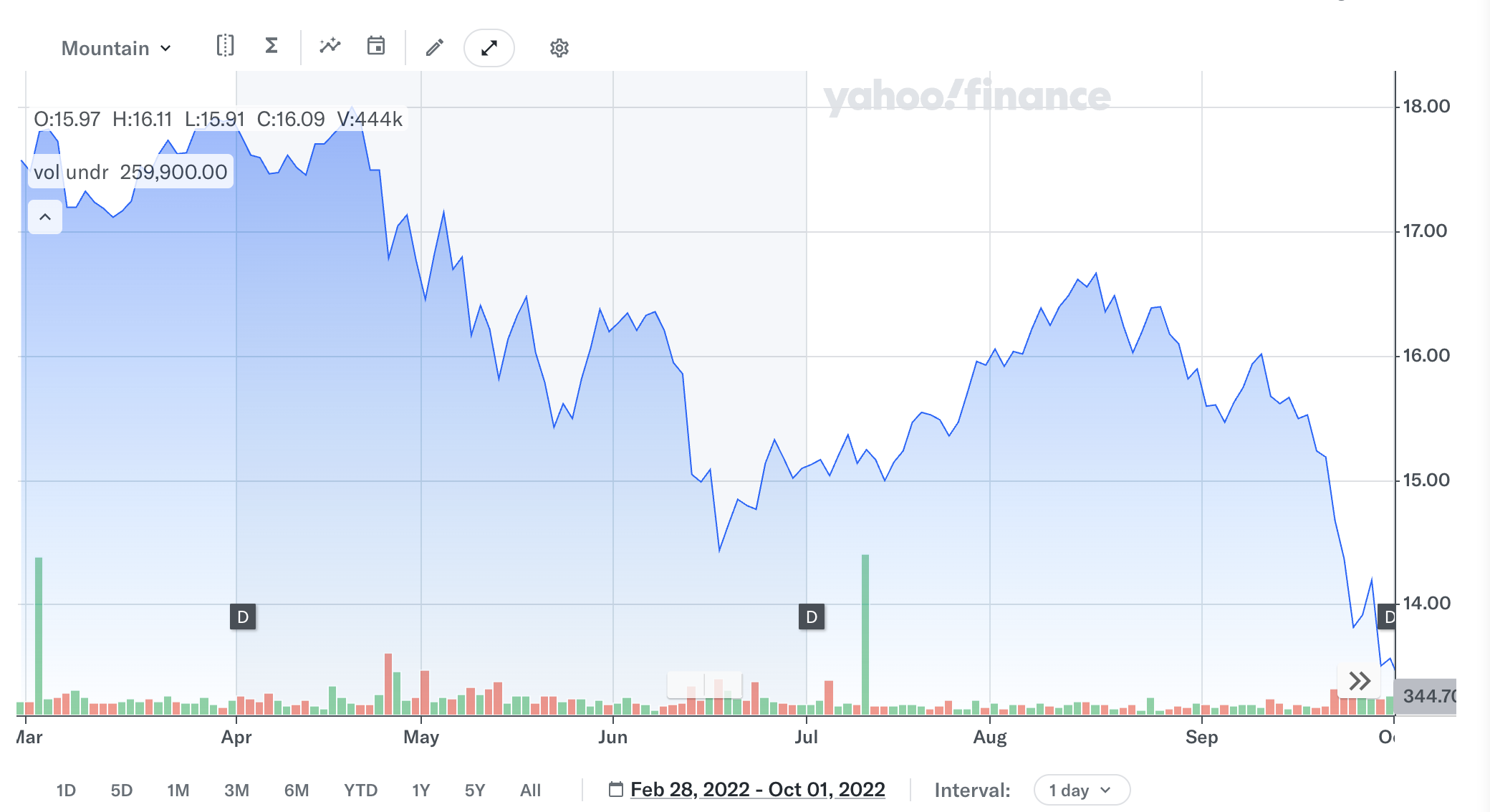
With the BDC sector already so out of favor, it would not take many negative economic metrics to recreate that angst.
Even a stopped clock is right twice a day, and if a recession actually turned up on our doorstep, the consequences for BDC prices could be very nasty.
Right Now
Of course, that's all dark speculation and does not reflect the current zeitgeist. Unrestricted government spending, the unique build-out of AI infrastructure, and record corporate earnings make a recession very unlikely.
Nonetheless, we do worry that BIZD - and the BDC sector generally - may have further to fall price-wise on the back of higher medium-term yields and the apparent pause in short-term rate hiking.
The 2, 5 and 10 year yields may have further to go for all we know.
Moreover, as many commentators have said and Chairman Warsh has suggested, the bond market may do the heavy lifting in bringing down inflation.
In an extreme situation, the recent 0.25% rate increase may be a case of "one and done".
If so, that would be a negative for BDC investing.
What To Do
Uncertainty is a constant in all investing, and at all times.
However, the current conflation of macro uncertainties against a backdrop of a slow M&A market, uneven BDC financial performance, and expensive medium-term borrowing argues for above-average caution.
Yes, BDC prices have fallen a lot already, but in our experience, they can fall even further if conditions line up unfavorably.
For our part, we'll continue to keep our heads down until some sort of offsetting positive catalyst comes along.
This might take some time.
In the interim, and as mentioned above, we'll keep refining which BDCs will be worth buying when the tide turns.