
BDC Common Stocks Market Recap: Week Ended January 30, 2026
BDC COMMON STOCKS
Week 5
Wall Street ended the trading week in the red as most of the Magnificent Seven stocks reporting earnings did not lift sentiments, contributing to tech trade sell-off, as the Federal Reserve hit a pause in its interest rate cutting cycle, and precious metals suffered a rollercoaster of highs before turning lower.
The S&P 500 (SP500), nonetheless, managed to cross the 7,000 level for the first time on Tuesday before retracing back. The main indexes then followed a rocky path downhill.
For the week, the S&P (SP500) added +0.3%, while the tech-heavy Nasdaq Composite (COMP:IND) dipped -0.2%, and the blue-chip Dow (DJI) fell -0.4%.
seeking alpha - wall street breakfast - january 31, 2026
Spinning Off
As the pullquote above indicates, the main indices headed in different directions this week, but remained within a narrow range.
The BDC sector, though, was marching to the beat of a different drummer entirely, and BIZD - Van Eck's exchange-traded fund composed only of BDC common stocks - fell (2.8%).
The S&P BDC Index - with a different methodology - performed a little less badly, down (2.30%).
If that's any comfort.
This was the worst price performance since mid-December 2025.
Like the week before, the number of BDCs moving up in price - 35 - was much greater than those standing still or increasing - 11.
Last week, the corresponding numbers were 34 and 12.
In Week 4, though, no BDC increased or decreased by (3.0%) or more.
This week, 13 BDCs were down (3.0%) or more, and only 2 went up more than 3.0%.
Worst
Here are the BDCs that dropped the most in price this week:
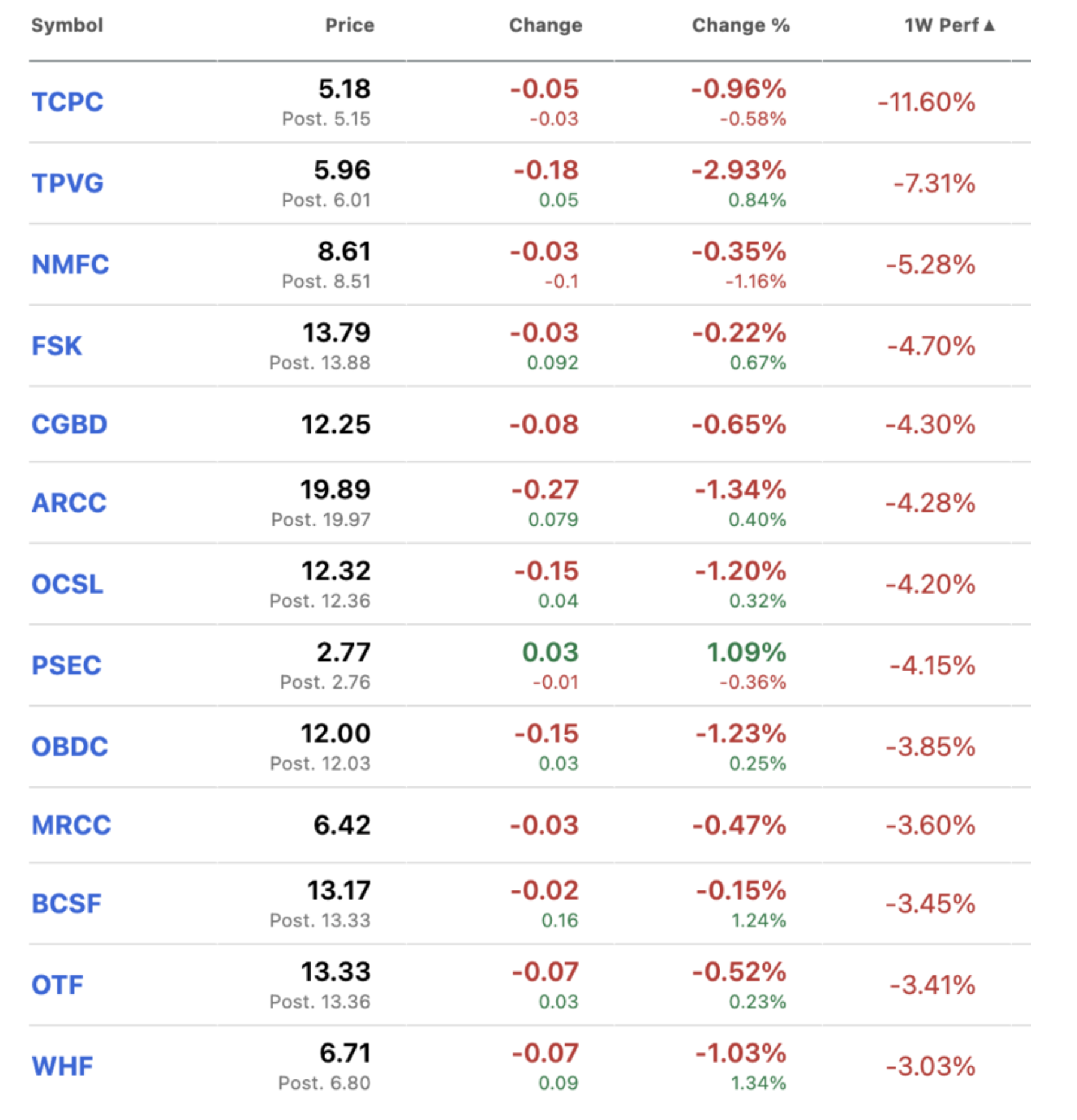
Topping the list - not unexpectedly - is BlackRock TCP Capital (TCPC) - following its admission to a (19%) drop in its net asset value per share (NAVPS).
Immediately on hearing the news on Friday last, we posted on X that a big price drop would be forthcoming, and that transpired.
We also wrote an in-depth article on the subject.
TCPC, after reaching a new price low of $4.88, has since perked up a little, closing Friday at $5.18.
Understandably, value buyers cannot resist the rock-bottom price.
We only warn, though, that the performance "preview" left out many important details about what is going on at the BDC credit-wise.
One cannot rule out further credit shoe-dropping.
What Are You Going To Do
We are interested to see how its renowned asset manager will react to this setback.
Will there be meaningful concessions or a capital injection plan?
Judging by the jeers from retail investors upon hearing of the $ 0.02-per-share one-time waiver of its management fee in the IVQ 025, some "shock and awe" measures will be necessary to rescue TCPC's reputation going forward.
Most of the other names on the table above are the usual suspects - BDCs that have underperformed for some time and are on most investors' Naughty list.
Odd
We were a little surprised to find Ares Capital (ARCC) on the list and closing out Friday at its lowest level since late November 2025.
It's a little ominous because ARCC is the largest public BDC and one of the most respected. In the past, a downshift in ARCC's price has been associated with a sector-wide slump.
Contrast
On the other hand - and illustrating how difficult it is to read the BDC tea leaves - Main Street Capital (MAIN) is trading up toward its 52-week and all-time high and is up 5.7% this year.
Capital Southwest (CSWC) - which, like MAIN, recently previewed positive IVQ 2025 results- is up in price by the same percentage.
Trinity Capital (TRIN) - operating in a completely different part of the loan market - is shooting up like a rocket in 2026, just shy of 15%.
As we've noted on X in near real time, the BDC has repeatedly reached new price highs this week.
WHERE WE STAND
For The Record
At the end of Week 5 - which is really 4 full weeks and one trading day in Week One - the BDC sector is down (1.3%), going by BIZD.
The S&P BDC Index - on a total return basis - is off (1.4%).
Not a great way to start the year.
As has become the norm in recent months, the BDC sector trails the S&P 500.
Light And Shade
It's not a fully dismal picture: 21 of the 46 BDCs we track are up in price in 2026 to date.
Still, only 6 BDCs are left that are trading at a premium to book value - the lowest number since the week ended November 21, 2025.
If one more BDC gets removed from that list, we'll be matching a record last set in March 2023.
High And Low
Only 5 BDCs are trading within 10% of their 52-week highs - 2 within 5% and 3 between 5%-10%.
By contrast, 26 BDCs are priced with 10% of their 52-week low - 15 (5%-10%) off and 11 within (5%).
Coming Very Soon
We believe much of the price volatility noted above relates to investors preparing themselves for earnings season, now just a few days away.
TCPC soured the mood with its disclosures, and investors rushed to sell BDCs like New Mountain Finance (NMFC), FS KKR Capital (FSK), Prospect Capital (PSEC), and Oaktree Specialty Lending (OCSL) - all of which have been bitter disappointments in terms of credit performance in recent years.
Investors have cast a wide net of worry, including even BDCs whose credit performance has been exemplary of late, such as Blue Owl Technology Finance (OTF) and the aforementioned ARCC.
As each BDC's earnings are released, we expect to see notable price increases or decreases as investor expectations are confirmed or confounded.
We'll be interested to see in mid-March - when the final releases are in - whether the sorry BDC metrics mentioned above continue or have improved.
Check out the Subscriber Tools section for the BDC Earnings Calendar, which shows the date of every BDC's earnings release and the time and date of the subsequent conference call.
So far, 26 BDCs have scheduled themselves.
It's going to be a drawn-out season as BDCs undertaking filing their 10-K can take a long time, so we'll still be hearing about the IVQ 2025 in the last month of the first quarter of 2026.
WHERE WE ARE HEADED
In The Batter's Box
As you can see in the Earnings Calendar, 6 BDCs will be reporting next week.
At the moment, neither the BDC Reporter nor the analysts, based on projected earnings, expect any significant change in the IVQ compared with the IIIQ 2025 for this cohort.
The BDCs involved are CSWC, Kayne Anderson (KBDC), Gladstone Investment (GAIN), ARCC, Golub Capital (GBDC), and TRIN.
Last quarter, we rated the financial performance of all 6 on a 1 to 5 scale, where 1 represents outperformance, 2 means performing in line with expectations, and 3 through 5 represent descending degrees of underperformance.
We attempt to be as clinical and systematic as possible in these ratings, but there is admittedly an element of subjectivity.
Anyway, in the table below, we're showing you each BDC's performance rating in the IIIQ 2025 and what we expect to see in the IVQ 2025.

Furthermore, we're including last quarter's recurring earnings per share (typically Net Investment Income Per Share or a preferred variant) and analysts' projections for IVQ 2025.
In addition, we're providing our best guess on whether the BDCs involved will maintain their "regular" monthly or quarterly dividend or cut it.
Diotto for the likelihood of a supplemental dividend.
These were very popular during the Golden Years of high interest rates and continued into 2025.
However, in 2026, these will become much rarer, as you'll see both in the table and throughout earnings season.
Last - but not least - we're showing the most recent change in NAVPS (IIIQ 2025 versus IIQ 2025) for each BDC - a useful proxy for overall credit performance.
Nutshell
The first half-dozen BDCs to report are expected to perform very well, notwithstanding difficult macroeconomic conditions.
At the moment, only GBDC seems to be in danger, based on the manager's comments in the IIIQ 2025, of cutting its dividend.
If these BDC results disappoint, though, both their individual stock prices and the sector as a whole could waver.
Next week will be an intriguing first test.