
BDC Common Stocks Market Recap: Week Ended May 22, 2026
BDC COMMON STOCKS
Week 21
Wall Street ended the week higher, though investors navigated sharp swings tied to Treasury yields, Middle East tensions, and another pivotal Nvidia earnings report.For the week, the Dow Jones Industrial Average (DJI) gained +2.1%, the S&P 500 rose +0.9%, and the Nasdaq Composite added +0.5%. - Wall Street Breakfast - Seeking Alpha - May 23 2026
pricing conditions in the public BDC sector
We’re running out of words to describe the pricing conditions in the public BDC sector.
Parlous, dire, and lamentable will all do.
What’s worse for loyal BDC investors in Week 21 of this grotty year, the sector’s price decline is happening against the backdrop of the major indices’ seemingly irresistible rise to ever-new heights - war, inflation, and tariffs notwithstanding.
Nor is it helping that Private Credit, of which the Business Development sector is a critical component, is being derided from every side by critics in the media, government, and in the banking community - each with their own agenda.
The boos and hisses from the peanut gallery - most of which is unjustified or inaccurate - must be sapping investor confidence, the mother’s milk of any market.
Anyway, this week the only BDC ETCF - Van Eck’s exchange-traded fund with the ticker BIZD - fell (1.8%) in price, and the differently constructed S&P BDC Index went down (2.2%).
In the case of both indices, that’s three weeks in a row in the red.
BIZD closed at a price of $12.38, (27%) below its 52-week high and (12.7%) lower in 2026.
The ETF is only (8%) above its 52-week low of $11.97, which, appropriately enough, occurred on April Fool’s Day.
Even the S&P BDC Total Return, which folds into its calculation the still-robust dividends paid out, is in “correction” territory: down (10.4%) in just these 21 weeks.
There’s more poor price performance to report when we descend from 36,000 feet and look at individual BDC performance.
Most notably, another 7 BDCs reached new 52-week lows.
As we noted on our BDC Publications X feed, the market is not only punishing those BDCs that have underperformed and/or cut their distributions.
Main Street Capital (MAIN), unofficially the BDC sector’s most popular stock, reached yet another price nadir on Friday of $48.95 (27%) below its 52-week high.
The lower-middle-market-focused BDC booked a higher net asset value per share in the IQ 2026, recently increased its regular monthly dividend, and made comforting noises about continuing to pay its generous supplemental dividend.
Investors have responded by fleeing in droves.
In other metrics: 39 BDCs dropped in price this week, including 17 by (3.0%) or more.
For reasons unknown, Oxford Square (OXSQ) saw many of its shareholders decamp, causing the tiny BDC’s stock price to drop (22%).
Even a big stock purchase by one of the BDC’s principals couldn’t halt the slide for long.
If Yahoo Finance is right, OXSQ’s market recap is down to $120mn and is trading at an all-time price low.
Also taking it on the chin was BlackRock TCP (TCPC), off by (10.1%).
The trigger there was likely the news splashed all over Bloomberg and elsewhere that the U.S. Attorney’s Office for the Southern District of New York is investigating its “valuation practices”.
Apparently, the government was impelled to start asking questions after TCPC announced in January a (19%) reduction in its NAVPS for the IVQ 2025.
All we’ll say is that if the government is going to probe any BDC that reports an outsized reduction in NAVPS, they’re going to have their hands full.
Just take a look at the NAV Change Table, and you’ll find 7 other BDCs whose NAVPs have dropped by (10%) or more in a quarter in the last 12 months. Some have done so multiple times.
We have strong opinions about this questioning of BDC valuation methods - a favorite stick used by Private Credit’s critics - but we’ll save ourselves for a future article.
Anyway, we could go on and on, but the picture is pretty clear: this was another crummy week to be a BDC investor.
WHERE WE ARE
Perspective
One bad week for BDC prices is not the end of the world, but as readers will already know, the sector has been taking a beating since February 2025, when BIZD and the S&P BDC Index reached a multi-year high.
Even on a total return basis, after clipping a bunch of BDC dividend coupons, the S&P BDC Index on a total return calculation is still about (20%) in the red.
If we look over at individual BDCs, 40 of the 45 we track are in the red price-wise on a YTD basis, 42 over the last 12 months, and 36 over a 3-year period.
Only when we look at BDC's total returns over a 3-year period do we find more stocks in the black than in the red.
We should also note that the 5 behemoth BDCs - those with AUMS greater than $10bn, which account for half of the sector’s size - are all in the red on a YTD, 1-year, and 3-year price basis.
By ticker, in alphabetical order, those BDCS are ARCC, BXSL, FSK, OBDC, and OTF.
Apparently, neither competing in the upper reaches of the middle market nor having huge portfolios is any guarantee of superior market performance, despite what many BDCs say to the contrary.
As of Week 21, only three BDCs are trading within 5%-10% of their 52-week highs.
The Few. The Proud.
The BDCs are Capital Southwest (CSWC), Gladstone Investment (GAIN), and Trinity Capital (TRIN).
All 3 have performed well financially, not only in the most recent quarter but also over several periods.
For what it’s worth, in the BDC Performance Table, you’ll see that all 3 BDCs have received a rating of 1 or 2 on our 5-point performance scale for the past 3 quarters.
On the other end of the price spectrum, 14 BDCs are trading within (5%) of their 52-week lows and another 14 within (5%-10%).
That means that nearly two-thirds of the BDC universe is in the dog house.
Overall, BDCs are priced at 72% of book, with only 6 names remaining at a premium.
WHERE WE ARE HEADED
Re-Working The Cliche
“It’s always darkest before the dawn” is a favorite expression of stock investors.
That’s actually a very hopeful sentiment that suggests prices can suddenly revive when everything seems lost.
Presumably, that is when we get a “capitulation,” and one group of investors moves out, and a more optimistic group moves in.
We’d love to say that time is upon us, but the evidence does not suggest so.
The volume of BIZD stocks traded - and BDC stocks generally - has been unusually high since September 2025 as investors have repeatedly sought to catch” the turn”.
In that period, though, BIZD has spiked briefly by a few percentage points 5 times, only to reach a new low shortly after.
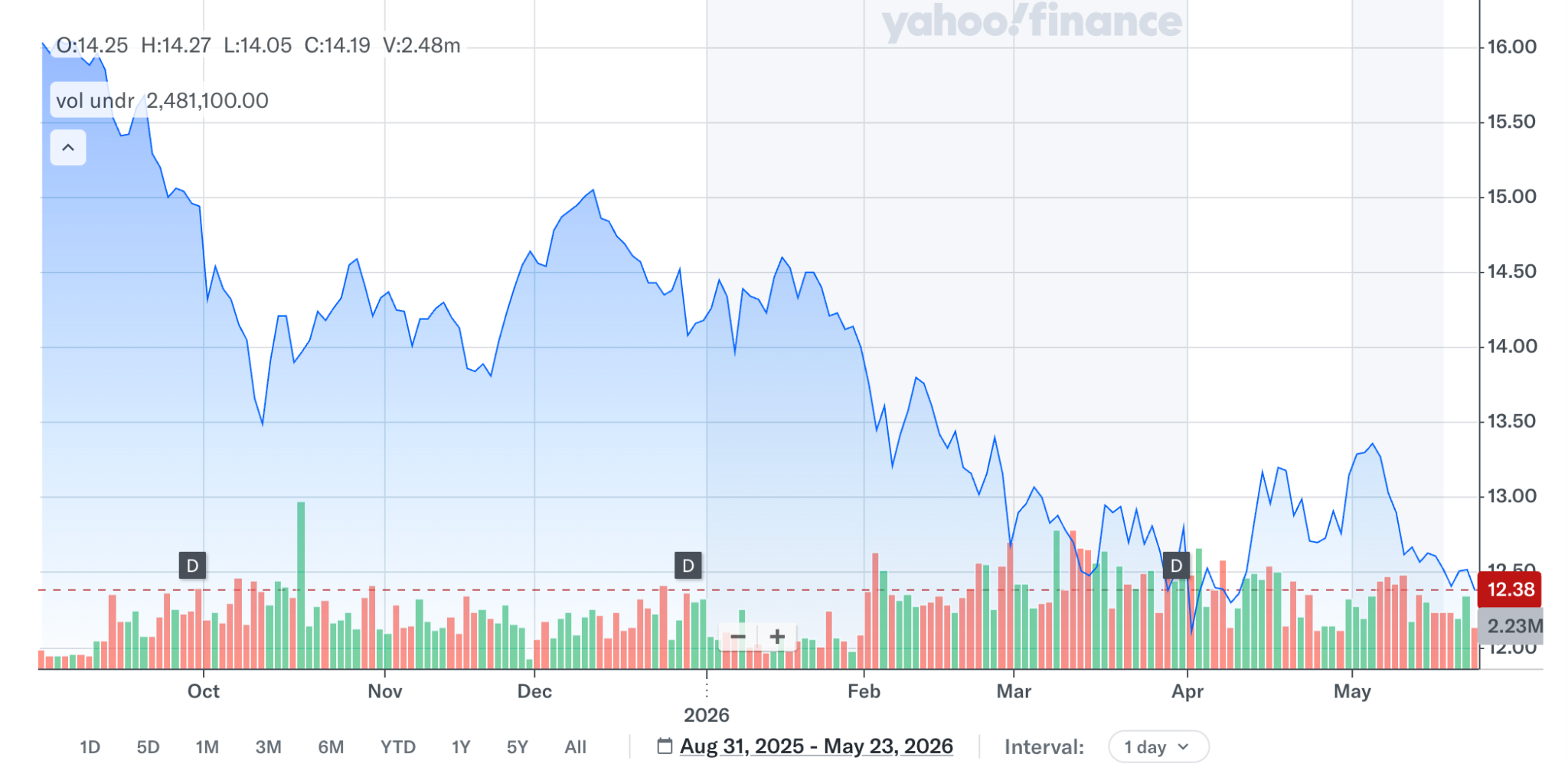
We had anticipated that analysts and investors might turn more bullish once the IQ 2026 earnings season was out of the way, and the way forward became clearer.
That didn’t happen. BIZD has dropped (4.0%) since the last BDC reported its latest results.
(We’re comparing BIZD’s dividend in April 2022 with the 2026 one, paid just recently).
So What Is It Going To Take?
“Nothing goes down forever” is another favorite saying of investors deep in the red who are grasping at straws.
It’s true, but 15 months of decline is not forever.
The BDC sector has been in decline for longer than that, and even if it hadn’t, “records are made to be broken”.
Or, put another way, the dawn could still be some way off.
For our part, like everybody else, we’re looking for the catalyst(s) that might prompt investors to return to the sector.
Unfortunately, as we flagged above, there seems to be no end in sight to the negative press about Private Credit and the financial condition of BDCs.
The government, as we’ve seen, is increasingly getting in on the act.
Admittedly, there is some hope that interest rates will flatten for a time, but markets still expect a rate cut in 2026, with more to come in 2027.
If the Fed, against the express wishes of the new Fed Chairman, actually raised interest rates, that would boost BDC earnings and might boost prices.
Those are long odds, though, and nobody seems to be taking them.
Yes, loan spreads for certain categories of loans have widened, but that’s not a universal phenomenon and may not last.
Certainly, this is nothing like 2022, when the banks and the syndicated loan markets went into hibernation, and Private Credit dictated the terms to borrowers.
In any case, wider spreads on new loans take some time to show up at the bottom line.
Also, many BDCs - as we discussed in an article this week - continue to face a “Big Squeeze” as their cost of borrowing on an unsecured basis increases as the last of their dirt-cheap notes booked in the ZIRP days roll off.
That’s a headwind that will last another year, and even then, who knows where medium-term rates for BDCs will be versus their lending yields?
Elephant In The Room
Finally, there’s the question of credit.
The full-scale credit shake-down that some commentators have been predicting has not happened.
By our count, 27 BDCs have reported non-accrual levels that are in line or better than BDC historical averages, and only 8 are in truly poor shape.
Yes, the BDC sector saw most players report lower NAVPS in the IQ 2026, but the (2.1%) overall drop is more akin to a bad cold than a full collapse.
Heck, 5 BDCs managed to increase their NAVPS this quarter.
We are on record as projecting that BDC NAVPS will actually increase in the IIQ 2026 over the prior period.
Nonetheless, the question mark about the future of a fifth or more of BDC borrowers in the “software” field remains.
When will that uncertainty be lifted?
We have no idea, and until that credit cloud breaks, it’s unlikely that the gloom hanging over BDC-land will go away
Should the war in Iran end, we might see a short-term boost, but that will affect the BDC sector favorably only at the edges.
UP NEXT